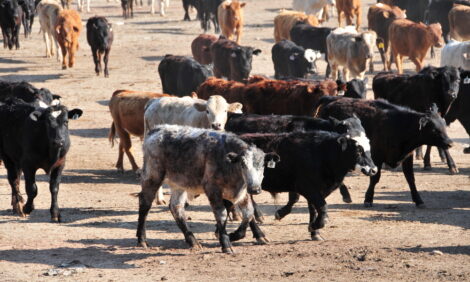
Why early fly control matters in beef cattle production systems
Dr. Erika Nagorske differentiates between primary fly types and their impact on an operation
 1 July 2026
 6 minute read
 By:
By: As temperatures begin to rise across cattle-producing regions, fly pressure quickly becomes more than a seasonal nuisance – it becomes a measurable drag on animal performance and herd health.
According to Dr. Erika Nagorske, veterinarian with Minton Veterinary Service, part of Four Star Veterinary Service, effective fly control starts with understanding the problem at its source: the different types of flies that affect cattle and how each behaves.
“A common misconception is that flies are flies. People don’t realize that there are multiple types of flies that can affect cattle and other livestock,” Nagorske explained. “It’s really important to understand the different types and then how to control and mitigate them.”
Her comments highlight a key challenge for producers—fly control is not a one-size-fits-all strategy. Instead, it requires identifying the species present and tailoring interventions accordingly.
Four primary fly threats in cattle operations
Nagorske outlined four primary fly types that each bring its own set of challenges, from simple nuisance behavior to direct impacts on production and health:
House flies
House flies are the most familiar. They do not bite, but their presence still disrupts cattle behavior.
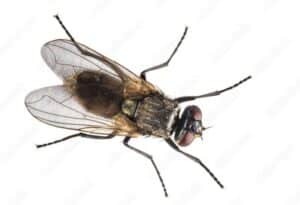
“They’re just annoying,” Nagorske said, noting their tendency to gather around feed, manure and spoiled organic matter.
Despite their relatively benign feeding behavior, house flies still affect performance. When cattle bunch together to escape flies, they experience increased heat stress and reduced feeding time.
“They’re going make cattle bunch to try to get the flies away from them, which can cause heat stress,” she explained. “Cattle are also going to spend too much time bunching and trying to get the flies off instead of eating and resting, which disrupts growth.”
Control strategies for house flies focus largely on environmental management. Removing manure and spoiled feed every two weeks helps disrupt breeding cycles, and baits, premise and topical sprays and biological controls like parasitic wasps can reduce adult populations.
An important consideration is that fly pressure often extends beyond a single operation.
“House flies can travel about two miles,” Nagorske said, emphasizing the need for consistent, season-long control programs.
Stable flies: A costly production challenge
While house flies are primarily a nuisance, stable flies present a more direct economic threat. These flies bite and feed on blood, typically targeting the legs of cattle.
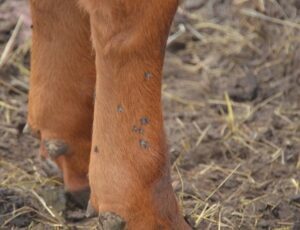
“These ones can be a problem because they like to bite animals and humans, and they take blood meals,” Nagorske explained.
Their impact on production is significant. Cattle respond by stomping, bunching and diverting energy away from growth. In addition, stable flies can contribute to anemia and transmit disease.
Nagorske pointed to the scale of the issue: “The USDA published a study that suggests that it’s $2 billion in loss of production every year because of stable flies.”
Because stable flies seek blood rather than organic material, control methods differ from those used for house flies. Sticky traps and targeted sprays – particularly applied to the legs – are critical. Managing vegetation is also essential, as stable flies tend to rest in tall grasses and weeds.
Horn flies: Persistent parasites affecting growth and carcass value
Horn flies present a unique challenge due to their behavior. They spend most of their time on the animal itself, typically clustering along the back.
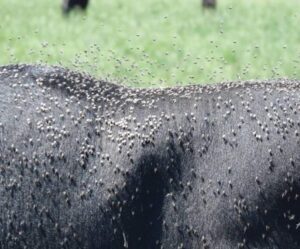
“They like to sit on the backs of cattle. They are a lot smaller than other flies, and they are just a huge nuisance because they also take blood meals from cattle,” Nagorske said.
Because horn flies remain on the animal, they are difficult for cattle to dislodge. This leads to constant irritation, reduced feed intake and lower weight gain. In addition, horn flies can damage hides, impacting carcass value at harvest.
Control strategies focus on direct animal treatments and interrupting the fly life cycle. Pour-on insecticides, insecticide ear tags and feed-through products all play a role in control. Feed-through additives help prevent larvae from developing in manure, which is a primary breeding site.
However, Nagorske cautioned against relying on a single method.
“You can’t just put an ear tag in them and think you’re good for the rest of summer because that’s not going to work on all flies,” she noted.
Face flies and risk of Pinkeye
Face flies pose a different type of threat, primarily affecting cattle health rather than just performance. These flies gather around the eyes and nose, feeding on secretions.
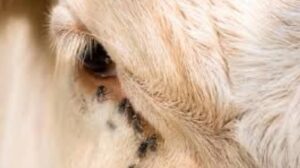
“They like to hang out on the face, and they feed on the secretions and tears coming out of the animals,” Nagorske explained.
Their presence increases the risk of Pinkeye, a condition that can lead to pain, reduced performance and even blindness.
“The risk of Pinkeye of is real. It can create blindness and reduce growth and production,” she said.
Control methods mirror those used for horn flies, including insecticide ear tags and feed-through products, both of which help limit fly populations and reduce contact with other cattle.
Matching control strategies to the environment
Fly control programs must also consider whether cattle are on pasture or in confinement, as each environment presents different challenges.
On pasture, long-lasting and self-applied solutions tend to be most effective.
“Ear tags are great options because you put them in and send them out,” Nagorske said, adding that back oil rubbers, sprays and fogs and feed-through products can also play a role.
In confinement systems, house flies are often more prevalent due to the concentration of feed and manure. As a result, environmental control becomes more important.
“Spraying the sides of buildings, and baits are a great tool for confinement,” she noted.
While strategies may differ, there is overlap. Many operations benefit from combining multiple approaches to address different fly species simultaneously.
Diagnosing the problem correctly
One of the most common mistakes producers make is applying the wrong control strategy for the type of fly present. Misidentification can lead to ineffective treatments and ongoing production losses.
Nagorske described a typical scenario: “I’ll get a call that the farmer has sprayed cattle and put out bait but says it’s not working, and when I arrive on the farm, I can see that it’s a stable fly problem.”
In these cases, treating cattle backs or using bait – methods effective for other flies – fails to address stable flies that target the legs and reside in vegetation.
“Thinking about what you see and where the fly is can be helpful to figure out what you are dealing with,” she said, reinforcing the importance of observation and diagnosis.
The production cost of fly pressure
Across all fly types, the underlying issue remains the same: reduced efficiency and lost performance.
“I think the bigger issue is the reduced growth and efficiency. When a cow is busy trying to get a fly away, it’s not going to go eat or drink. And that’s stressful,” Nagorske said.
Beyond performance, disease transmission—particularly Pinkeye—adds another layer of risk. Together, these factors make fly control a critical component of herd management rather than a secondary concern.
While cows often receive the primary focus, calves are equally susceptible to the effects of fly pressure.
“You definitely want to pay attention to the calves as well. They’re going to also have issues with energy and resources if they have a high fly burden,” Nagorske noted.
Treatments such as pour-ons and ear tags can be used on calves, though feed-through options may be less applicable depending on intake.
Timing is everything - start early
Perhaps the most critical takeaway from Nagorske’s guidance is the importance of early intervention. Waiting until fly populations peak in late summer makes control far more difficult.
“Start early because for every single fly you kill in April and May is 80,000 less in August and September. This is because fly life cycles are short and they’re very prolific,” she emphasized.
In regions like the Midwest, the ideal time to begin is shortly after the first sustained warm-up.
“After your thaw cycle is when you want to start thinking about it – the sooner, the better,” Nagorske said.
Building a comprehensive program
Ultimately, successful fly control requires a proactive, multifaceted approach. Producers should work closely with veterinarians or animal health professionals to develop tailored programs that consider fly species, environment and herd dynamics.
“I encourage everyone to start early, contact your veterinarian for a plan and be ready for flies because you don’t want to be behind on the eight ball when it comes to fly control,” Nagorske concluded.
As seasonal fly pressure intensifies, taking a strategic approach now can help protect cattle performance, health and overall profitability throughout the summer months.

Sarah Mikesell
Sarah Mikesell grew up on a five-generation family farming operation in Ohio, USA, where her family still farms. She feels extraordinarily lucky to get to do what she loves - write about livestock and crop agriculture. You can find her on LinkedIn.