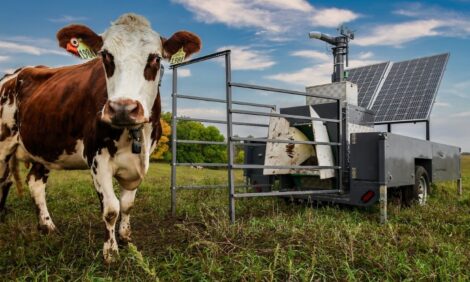
Smart Calf Rearing Conf. Producer Day - A “game changer” for calf research: UW–Madison installs Förster-Technik CalfRail
Förster-Technik’s Jan Ziemerink says the CalfRail delivers unprecedented feeding precision and data insights for dairy calf farmers, nutritionists and researchers
 24 February 2026
 5 minute read
 By:
By: Editor's note: From September 25 to 27, the international Smart Calf Rearing Conference took place at the University of Madison in Madison, Wisconsin. Organized by Förster-Technik, Trouw Nutrition, the University of Guelph and the University of Wisconsin – Madison, the conference brought together 245 participants from around the globe to discuss the latest findings in calf physiology, health, housing and welfare, and 18 renowned speakers shared their expertise and research insights. Participants also had the opportunity to visit the university’s calf barn, where innovative solutions for calf rearing were showcased – including the CalfRail automated feeding system for individual housing, developed by Förster-Technik.
Dr. Lautaro Rostoll Cangiano, an Assistant Professor at the University of Wisconsin-Madison, and Jan Ziemerink, the CEO of Förster-Technik North America, were recently interviewed by The Dairy Site’s Sarah Mikesell during the Smart Calf Rearing Conference Producer Day held at the University of Wisconsin-Madison’s calf rearing facility near Arlington, Wisconsin, USA.
Dr. Cangiano, tell me about the Förster-Technik CalfRail automated calf feeding system that you've installed in this facility.
We're really excited about this system. We installed it about a month and a half ago. This is a game changer for our research program. It allows us to do a lot of different types of research. We can manipulate more diets, so we can look at things a lot more closely than we ever did before.
The data that we collect is also really valuable for our research program. We can get individual intakes from each of the calves and drinking speed. It's a valuable health outcome that we can use in our own research as well. We can also play around with different planes of nutrition for these animals and see how they respond and follow some of these studies all the way to, hopefully, lactation.
As we discussed during the technical and producer conference, we're really interested in doing studies related to waste milk, and the impact it has on development. Then we can work on some specific strategies, and we try to improve so that we can still feed it to the animal without having some negative outcomes.
CalfRail is a unique system. I think we're the only university in the US that has a system like this. We can house around 80 to 100 calves here at our facility, and we can get individual intake and drinking speed from every single one of them. We're really excited about this system and the data it can generate.
What led you to the decision to install this system?
We had a previous relationship with Förster-Technik for research. We started discussing, for our specific facility, what kind of system would make the most sense from a research perspective and from a management perspective. Then, we prioritized keeping cows individually housed because that suits most of the type of research we do here. There's really no other system that can allow us to have an automated feeding system but still have individualized housing. But this system allows for that and works with our research needs.
It's only been a few weeks, but the initial data looks good that you're seeing from the study that's going on behind us, right?
Yes, it does. Growth rates are a lot higher than we had with our conventional systems. Also, something that I'm really impressed by is that calves become used to being fed on the system very quickly. I thought we were going to need to be there for the first feeding, and then like the next five or six times. But after the second or third feeding, the calves were already picking it up very well. We're excited about what we have seen so far. Again, we're still learning. This is a new system in our facility, but things are looking good.
Jan, we're going to shift gears and talk to you. What does a system like this offer to calf producers on the farm?
The CalfRail system can be installed and used on-farm. It’s really a labor saver, offering calves smaller portions and multiple feeding times. We can feed the calves multiple times – up to seven times a day. Here at the University of Wisconsin, we are feeding four or five feedings about 2.5 liters per feeding. This provides about 10 to 12 liters per day which means a lot better gain, and the calves are more satisfied.
After 4 to 5 weeks on full feed, we start weaning automatically. The feeder will begin to reduce the amount of milk calves receive. With this system, the calf can either miss a feeding, or we can cut a 0.5 liter out of the feeding slowly over time. That's a big advantage similar to what we do in group housing. With a system like this, it works very well.
The CalfRail also fully automatically cleans the system. Small barns, large barns, new buildings or existing buildings – the CalfRail is a modular system that can be adapted to any farm.
Because of the data received, you can see when those calves are going off feed. Or if you've got a disease challenge, you might be able to see that sooner, right?
Correct. You’ve got all the data showing consumption, drinking speed and number of visits to the system. And it’s all on the cloud, so it’s on your phone, tablet or laptop wherever you are.
For universities, all the students that are working on a research project can be on the cloud, and they can see all the data and what’s happening without making changes. They can see what the calves drink and can see them drinking live in real-time no matter where they are. But they can't accidentally make changes, so that is good.
The data can all be sent via your phone or laptop. You can share it with your nutritionist and farm team, getting it to the right person to analyze the data from what's been happening that day if you wanted. It's always available, which is good for researchers, nutritionists and farmers.
Speaking about data, precision feeding seems to be the direction the industry is moving, right?
Absolutely, we see it a lot in Canada, and we are starting to see it here in the US now. Farmers are ready to do it. For example, with this system, you can feed the calves for eight to nine weeks. But you can also feed them for three weeks on the CalfRail then move them into groups. It's an advantage because you’ve got more gain.
Farmer are looking for earlier lactations. We've seen that some cows are now milked at 21 to 23 months. Some people have talked about 15% to 17% more milk in the first lactation. That is a tremendous advantage from this system.
Of course, labor is going to continue to be a problem. Calf welfare is another concern. Consumers are talking about this, and we see a shift from calves in single pens to pair and group housing. For example, in Canada by 2031, after four weeks of age, calves will have to be put in groups. This is where the industry is headed and having a flexible, efficient feeding system will be important for dairies and calf farms.
Learn more about Förster-Technik’s CalfRail.

Sarah Mikesell
Sarah Mikesell grew up on a five-generation family farming operation in Ohio, USA, where her family still farms. She feels extraordinarily lucky to get to do what she loves - write about livestock and crop agriculture. You can find her on LinkedIn.