C-Lock Symposium: How genetic selection using productivity-focused breeding delivers measurable emissions reductions
ABS Global outlines how genetic selection emerges as a scalable pathway to lower emissions
 20 May 2026
 6 minute read
 By:
By: At a time when the livestock sector faces mounting pressure to reduce greenhouse gas emissions while maintaining productivity, genetic selection is emerging as one of the most scalable and permanent solutions.
Speaking at the C-Lock Symposium in Denver, Colorado, Dr. Matthew Cleveland, Senior Director of Global Bovine Sustainability at ABS Global, outlined how commercial breeding programs are beginning to integrate sustainability traits – particularly methane reduction – into selection strategies without sacrificing profitability. Drawing on a beef-on-dairy case study, Cleveland emphasized that genetics offer a unique opportunity to align environmental goals with real-world production systems.
“It’s really important that we look at genetic innovation as the most important tool for the permanent reduction of environmental impact from livestock production and to create a more sustainable supply chain,” Cleveland said.
Sustainability must start with scale and profit
Cleveland framed the challenge facing the industry in practical terms: feeding a growing global population while reducing environmental impact. But unlike many sustainability discussions, his perspective focused squarely on scalability within commercial systems.
“Animal agriculture continues to be a critical contributor to sustainably feeding people,” he said. “The challenge we have is that we need to have truly scalable solutions that create value for everyone along the supply chain.”
That requirement for scalability immediately narrows the field of viable solutions. According to Cleveland, innovations that cannot be implemented across millions of animals or that fail to deliver economic returns at the farm level are unlikely to succeed.
“Sustainability requires profitability,” he said. “We can't expect a production system to add cost to their system without some additional benefit on the other side.”
This principle underpins ABS Global’s approach. While methane reduction is a key objective, Cleveland stressed that producers will not adopt new genetics or technologies unless they improve or at least maintain profitability.
“At the end of the day, if we don’t have profitability across the entire supply chain, we don’t have sustainability,” he added.
Disconnect between supply chain goals and farm-level decisions
One of the central barriers to adopting sustainability traits – such as lower methane emissions – is the disconnect between long-term supply chain goals and short-term farm economics.
Retailers and food companies are setting ambitious climate targets for 2030 and beyond, but those signals often fail to reach producers in a meaningful way.
“At the end of the day, it’s the producer at farm level who’s going to make that genetic decision,” Cleveland said. “We can create EPDs or EBVs, but if the farmer doesn’t see value in his operation using it, there’s not going to be any impact.”
This lack of alignment has historically limited investment in genetic strategies that could benefit the entire value chain. Without clear incentives, producers tend to prioritize traits with immediate economic returns, such as growth rate, feed efficiency and carcass quality.
“There’s a disconnect between long-term value creation and short-term return on investment,” Cleveland explained.
As a result, sustainability traits like methane emissions often carry little or no economic weight in breeding decisions.
Productivity gains already reduce emissions
Despite the lack of direct incentives for methane reduction, Cleveland presented evidence that traditional selection for productivity and efficiency is already delivering measurable environmental benefits.
Using ABS Global’s NuEra Genetics program as a case study, the company analyzed how genetic improvement in beef-on-dairy systems impacts emissions intensity. Developed over more than a decade, the program focuses on selecting beef genetics optimized for dairy systems.
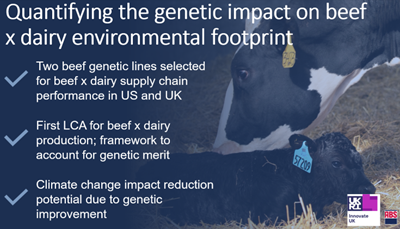
The results were clear: genetic lines selected for profitability and efficiency reduced emissions intensity by between 4.6% and 8.8% per kilogram of carcass weight.
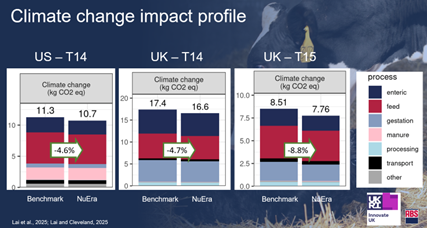
“We’re making genetic improvement for profitability, and we’re also bringing along a reduction in greenhouse gases,” Cleveland said.
These reductions are largely driven by improved feed efficiency and faster growth, which reduce the number of days animals spend in production, thereby lowering total emissions per unit of output.
Cleveland emphasized that while percentage reductions may seem modest, their cumulative impact is substantial when applied across entire production systems. In the UK alone, widespread adoption of improved genetics could reduce emissions by nearly 1 million tonnes of CO₂ equivalent over five years while continuing to improve productivity and profitability.
Methane as a trait: promise and challenges
While productivity-driven gains are already contributing to lower emissions, the next frontier is direct for methane traits. However, Cleveland acknowledged that this remains a complex and unresolved challenge.
Adding to the complexity is the variability in methane emissions between animals. Data collected through C-Lock’s GreenFeed system show that animals have significant variation in both feed conversion and methane production, even within similar production environments.
This animal variability suggests there is genetic potential to reduce methane emissions but translating that into practical breeding strategies remains a work in progress.
“With the exception of a few markets, there is a lack of incentives for direct reduction of methane,” he explained. “If you gave me a methane EBV right now, I would put a zero economic weight on it.
This creates a dilemma for breeders: incorporating methane traits into selection programs requires predicting future market conditions, including the potential for carbon pricing or sustainability premiums.
Looking ahead, Cleveland emphasized that market demand and economic signals will ultimately determine how quickly sustainability traits are adopted.
“Commercial genetic improvement is guided by market signals,” he said.
As retailers and consumers place greater emphasis on sustainability, those signals are likely to strengthen. However, for meaningful change to occur, incentives must be aligned across the entire supply chain.
“We have to be able to demonstrate that with real money,” Cleveland said, referring to the need for clear economic benefits at the farm level.
Microbiome research offers next step
One promising area of research is the role of the rumen microbiome in methane production. ABS Global is currently exploring how microbial gene abundance could be used as a phenotype for genomic selection.
Early findings suggest that microbiome composition is heritable and linked to traits such as feed efficiency, animal health and methane output. However, Cleveland cautioned that the industry is still far from implementing microbiome-driven breeding at scale.
“It’s not obvious what we do with this information in a commercial breeding program yet, but there’s a lot of interesting finds coming out of our studies,” he said.
Collecting microbiome data at scale presents logistical challenges, and researchers are still working to determine how best to integrate this information into selection indices.
Nevertheless, Cleveland believes this area holds significant potential for future gains, particularly when combined with existing selection for productivity.
Implementation requires more than genetics
A recurring theme in Cleveland’s presentation was that genetic improvement alone is not enough. Successful implementation depends on a range of enabling technologies and management practices.
These include artificial insemination (AI), sexed semen, reproductive management and robust data collection systems. Without these tools, even the best genetics cannot deliver their full impact.
“Genetic improvement is really just the beginning of that story,” Cleveland said. “We need to make progress towards things that actually matter to the supply chain. We've done a good job for what you might call traditional beef and dairy production traits. But when we talk about sustainability traits, what does that actually mean? And how do all the pieces fit together to create genetic management.”
In many beef systems, limited adoption of technologies like AI around the world remains a significant barrier to disseminating improved genetics. Overcoming these barriers will be critical to scaling sustainability gains across the industry.
ABS Global is also looking at diet composition, feed and water intake and rumen composition and their connection to enteric and whole-animal emissions as part of their new breeding approaches.
Genetics as a long-term solution
Despite the challenges, Cleveland is optimistic about the role of genetics in reducing methane emissions and improving sustainability in livestock production.
Unlike many interventions, genetic improvements are cumulative and permanent, meaning gains achieved today will continue to deliver benefits to future generations.
“Interventions have to work at farm level, but they have to be scalable,” he concluded.
As the industry continues to balance productivity, profitability and environmental impact, genetic selection, particularly when aligned with market incentives, is poised to play a central role in shaping the future of sustainable beef production.
Watch Dr. Cleveland's presentation from the C-Lock Symposium here.

Sarah Mikesell
Sarah Mikesell grew up on a five-generation family farming operation in Ohio, USA, where her family still farms. She feels extraordinarily lucky to get to do what she loves - write about livestock and crop agriculture. You can find her on LinkedIn.