SmartFarm's automated health and welfare index evaluates cattle welfare
This tool gives producers a real-time snapshot of their herd health and can be useful for overall decision-making
 25 May 2026
 8 minute read
 By:
By: Dairy cattle welfare is a major concern among consumers and industry stakeholders, such as farmers, processors and retailers. Poor cattle welfare can lead to substantial health issues, including lameness, mastitis and infertility. This leads to losses in productivity and, therefore, farm profitability. Whilst UK farms must meet standards set by processors, retailers and farm assurance schemes, the associated welfare assessment methods often focus on absence of a negative indicator, e.g., lameness or dirty cows, as a proxy for welfare. However, absence of negative welfare is not an indication of “positive welfare”.
Qualitative Behavior Assessment (QBA) is the gold standard method to evaluate welfare and is one of the few methods we have for identifying and assessing positive welfare. It incorporates information on animals’ body language; indicators that have not previously been used. QBA has been included in the Welfare Quality® protocol.
QBA relies on human observations and evaluation of animal behavior. This is time-consuming leading researchers to evaluate alternative and/or automated data collection methods. The use of automated Precision Livestock Farming (PLF) technologies (such as wearable sensors) as management tools has the potential to automate data collection for welfare assessment thereby reducing staff time and potentially improving farm profitability. Although PLF tools are useful for identifying ill-health or a change in an animal’s state, there is scope to use these tools to accurately measure aspects of positive welfare, informing decisions around animal health, production, and consequently profitability.
The ability to use technology that is already on the farm to understand more about an animal’s welfare in an automated way would give farmers a better understanding of their herd health and dynamics in real time. It could also provide a better return on investment from the PLF technologies that they are already using for other purposes. PLF-derived data is verifiable, objective (farmer/processor assessments of welfare may be biased) and non-invasive, reducing any negative impacts that might be associated with animal handling. Although PLF tools are not intended to replace good stockmanship and the skills required to interpret auditory and visual cues, they are a useful tool to support farmers to improve the accuracy of welfare evaluation and hence the care of their animals.
This project aims to test the possibility of using data automatically gathered from ankle-mounted accelerometers as an indicator of positive welfare and assess the accuracy by comparing sensor data with the gold-standard welfare measurement, QBA.
A previous feasibility study, undertaken with First Milk, identified farms with existing animal-mounted activity monitoring technology, such as ankle mounted pedometers. There was no limitation on the type/brand of sensor or data collected and 16 farms with sensors were enrolled. These farms were using sensors from three different companies. However, only one type of sensor could provide sufficiently detailed data to allow further analysis (an ankle-mounted pedometer, IceTags, Peacock Technologies, Edinburgh, UK). Therefore, detailed sensor data from four farms (one in the north of England and three in the Southwest of Scotland) were collated and analysed. QBA was conducted on each farm, once during housing periods (February 2022) and once during periods at pasture (June 2022). This was conducted by a single trained researcher to ensure consistency. A total of 20 animals were randomly selected and assessed on each visit.
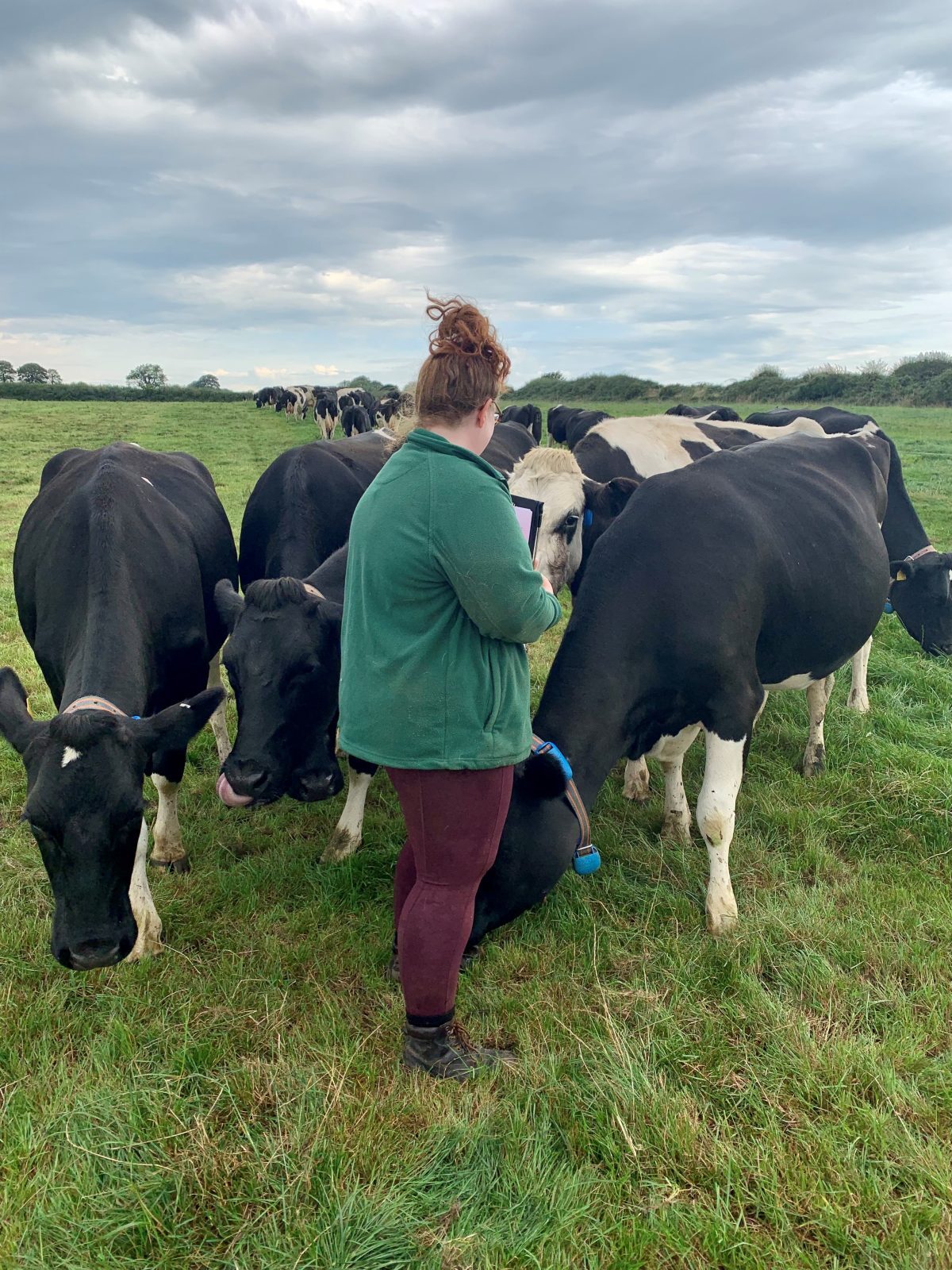
The QBA assessment consisted of scoring cow behavior against 20 descriptive terms from the Welfare Quality® protocol. Terms were scored on an unstructured visual analogue scale (VAS) running from minimum to maximum (i.e., a 12.5cm long line, where ‘minimum’ = the expressive quality indicated by the term is entirely absent and ‘maximum’ = the expressive quality is dominant in observed animals). Following each visit, QBA data was processed – the length between the minimum point and the assessor’s mark was measured and converted into a score.
Statistical analysis allowed the QBA and sensor data to be compared, identifying whether the sensor data could be used to predict an animal’s QBA score.
As a larger, follow-on project, 15 First Milk and Lactalis farms across Ayrshire, Dumfries & Galloway and Cumbria participated in the study. Of these, five already used the same ankle-mounted pedometers as in the initial study, from which data was available to researchers.
For the remaining ten farms, two sets of sensors were deployed on two farms, each set contained 50 sensors, with 100 sensors active across each pair of farms being assessed at a time. They remained on farm for one month before being moved to another two farms: taking five months to get the sensors around all ten farms.
While sensors were on cows, QBA was carried out on all farms a total of four times, twice when cows were housed and twice when grazing. The same QBA protocol as described above was used in this study.
In addition, researchers had access to more granular data, with the sensor data now including time stamps. This is allowing further analysis to be undertaken to evaluate behavioral synchrony; animals doing the same thing at the same time. Behavioral synchrony is associated with positive welfare but is currently difficult to measure on farm. The ability to measure behavioral synchrony to predict QBA will help validate further the use of sensors to assess positive welfare.
The results
Data derived from QBA during the feasibility study showed that a total of 70.7% of pasture-based cows exhibited behaviours associated with positive mood, compared to 32.7% of housed cows (Figure 1). A total of 40% of pasture-based cows exhibited scores associated with active behaviors compared to 57.1% of housed cows.
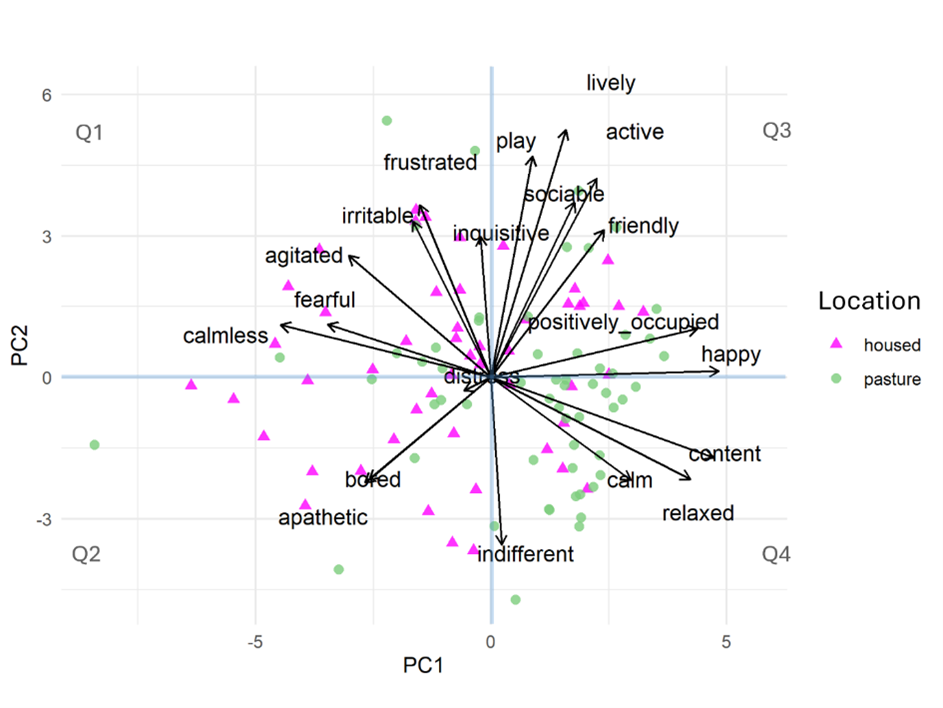
Several sensor-derived variables were significantly correlated with QBA measures. Step count measured via ankle-mounted pedometers and maximum standing bout duration positively correlated with QBA scores associated with mood. This suggests that an increased step count, coupled with longer maximum standing bouts are indicative of positive welfare on dairy farms, both for housed cows and cows at pasture. Maximum lying about duration was negatively correlated with QBA scores associated with mood, with lower maximum lying bouts associated with more active behaviors (e.g. agitated, frustrated, playful, lively).
Step count may be higher for cows at pasture due to behavioral changes such as grazing behavior, and due to increased walking distances to the milking parlor. An increase in step count at pasture, coupled with the knowledge that cows tend to have improved welfare at pasture, may account for the correlations seen between QBA data associated with positive welfare and step count (from sensor) in this dataset. However, the relationship between welfare, housing and standing time is less clear.
For example, increased standing times have been associated with uncomfortable lying surfaces, comfortable standing surfaces, or thermal stress. Decreased standing times are often associated with increased lameness. This feasibility study observed a negative relationship between QBA term ‘happy’ and mean standing bout frequency at pasture. And in housed cattle we observed a negative correlation between QBA term ‘calm’ and mean maximum standing bout duration and between ‘relaxed’ and mean maximum lying about duration. The combination of increased step count with longer maximum standing bouts observed for housed cattle in this feasibility study may, therefore, be an important indicator of positive welfare.
The quality of housing on the four farms in the feasibility study were of a similar standard, with the follow-on project collecting data from farms with a variety of housing qualities to better understand these correlations.
Despite the variations observed in sensor data for housed and pasture-based animals in this study, it was still possible to predict an animal’s mood as being positive or negative with 61% accuracy, based on sensor data alone from 4 farms, regardless of location. This suggests that it is possible to use data from sensors already being used on farm for management purposes to understand more about the level of positive cow welfare in an automated way.
Analysis and interpretation of data collected as part of the follow-on project is ongoing.
The impact
Focusing on positive mood indicators allows farmers to move away from the outdated “lack of negative” aspects of animal welfare which are standard in many assurance schemes. Assurance and processor welfare schemes could be updated to incorporate sensor data collected on farms as a proxy for positive welfare. This would provide an objective understanding of welfare levels on farm, removing any consumer doubt. Utilizing technologies that are already in use for other aspects of management can reduce labor and time demand on farmers, allowing more time to be allocated to other important tasks. Furthermore increased assessment frequency would be possible to make assurance schemes more reliable.
Information on the behavior and welfare of a farmer’s herd will help them to make better informed management decisions for their cows. Cows with improved welfare tend to have improved health, saving on costs associated with disease and injury, as well as supporting higher milk production, making a farm more financially resilient.
An indirect added benefit of this improved welfare, health, and production is reduced inputs into the farm system, overall lowering costs and carbon emissions per unit of milk produced.
There were limitations to this research, especially as there was only one commercial company who could provide sufficient data for analysis. Engaging with industry on these findings may help to encourage technology companies to collaborate with researchers to help add value to the PLF tools they provide. Demonstration of additional benefits of PLF tools, such as increased welfare monitoring or reduction of carbon footprint from improved fertility, health, and management could further increase uptake of these technologies particularly if an improved return on investment is demonstrated.
The future
Giving farmers a tool to better manage their business, processors the ability to positively promote UK dairy, and providing confidence to the consumer all help to improve resilience in the UK dairy industry.
It gives PFL technology providers the opportunity to extend the usefulness of their products/services, increasing competitiveness and potential uptake.