Optimizing ruminant health through OVN Optimum Vitamin Nutrition®
dsm-firmenich’s latest guidelines redefine precision vitamin supplementation for dairy and beef herds worldwide
 4 February 2026
 6 minute read
 By:
By: Vitamins may represent only a small fraction of ruminant diets, but their impact on animal health, productivity, and welfare is profound. Getting the right balance is critical, and it’s a balance that continues to evolve as nutrition science develops and beef and dairy genetics advance.
To help farmers and nutritionists fine-tune supplementation, dsm-firmenich released its OVN Optimum Vitamin Nutrition® (OVN) Guidelines 2022 for ruminants, followed by an important 2025 update that includes new recommendations for 25-OH D3 (Hy-D®). These updated benchmarks are grounded in scientific research and real-world data, designed to help producers tailor vitamin levels to their herds’ needs and optimize both animal performance and farm sustainability.
“dsm-firmenich organized a webinar with two industry experts to discuss this idea of ‘what’s the right vitamin levels on my farm’ and introduce the updated OVN Optimum Vitamin Nutrition® Guidelines 2022,” said José-María Hernández, Global Special Nutrients Manager, Animal Nutrition & Health at dsm-firmenich. “We’ll share important discussion points here in the article, but the webinar covers a lot of additional information if you want to learn more.”
Vitamins: Small nutrients, big impact
Vitamins A, D and E are essential for ruminant health and productivity, influencing everything from growth and reproduction to milk yield, bone development and immunity.
Vitamin A supports vision, reproduction, health, immune function and tissue growth; it’s vital for calves, lactating cows and beef cattle alike.
Vitamin D regulates calcium and phosphorus metabolism and plays a crucial role in bone health, immune response and milk yield. In beef systems, it also affects gene expression linked to muscle growth and development, carcass weight and meat quality.
Vitamin E, a potent antioxidant, enhances reproductive efficiency, immune defense and muscle integrity, helping animals resist oxidative stress during demanding production stages.
“Despite these well-known benefits, determining the “right” level of supplementation remains complex,” said Dr. Luis Fernando Tamassia, Global Innovation Lead Ruminants at dsm-firmenich. “Requirements vary depending on forage quality, diet composition, environmental stress, animal physiology and production goals. Plus, poor pasture conditions, stress and intensive farming practices can all contribute to deficiencies, affecting overall herd performance.”
The science behind the OVN 2022 Guidelines
The OVN 2022 guidelines mark a significant step toward precision feeding as more and more producers are tailoring vitamin nutrition to the specific needs of animals based on their production phase, health status and environmental conditions.
Rather than applying a single standard for all ruminants, the OVN framework integrates the latest research and field data to recommend phase-specific and condition-specific vitamin levels.
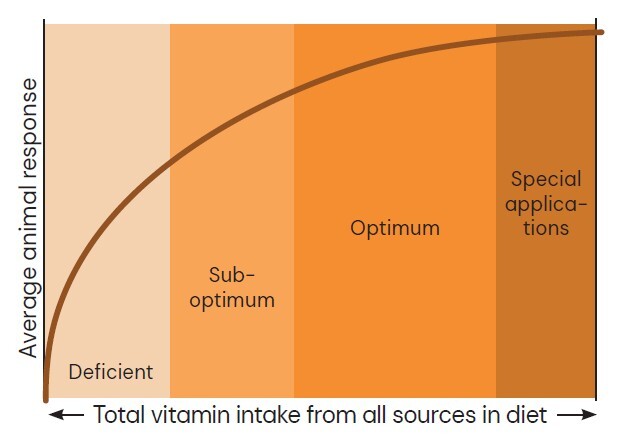
Precision feeding considers factors such as the physiological stage of the animal, production goals, and farm management practices. By tailoring supplementation to the specific needs of the herd, farmers can enhance efficiency and reduce waste.
This precision approach not only improves animal health and performance, but it aligns with global goals for sustainable livestock production, reducing disease incidence, improving reproductive efficiency and lowering the carbon footprint per unit of milk or meat produced.
Avoiding the twin risks – deficiency and excess
Vitamin management in ruminants involves a delicate balance. Experts estimate the dairy industry over-provides for about half the dairy population and under-provides for the other half. Too little may result in health and productivity problems; too much might waste resources.
The OVN guidelines address both extremes by offering evidence-based targets designed to sustain productivity without oversupplying to animals.
Deficiency-related problems include:
• Weakened immune function, leaving animals vulnerable to infections
• Reproductive failures such as reduced fertility and calving difficulties
• Declines in milk production and slower growth in calves or feedlot cattle
By implementing the OVN guidelines, farmers can minimize the risks while avoiding unnecessary costs.
Factors influencing vitamin needs
Ruminant vitamin requirements are dynamic, not static. The OVN approach recognizes several major influences that can shift the balance:
1. Forage quality
The vitamin content of silage, hay and other feeds depends heavily on harvest timing, storage and preservation methods. Forages exposed to prolonged sunlight or oxidation can lose a significant proportion of vitamins A and E before feeding. Poor-quality forage often lacks sufficient vitamins, increasing the need for supplementation.
2. Environmental and metabolic stress
Stress conditions, whether from heat, transport or high milk output, can deplete vitamin reserves in the body, making additional supplementation crucial.
3. Bioavailability of vitamin sources
Not all vitamins are created equal. Some vitamin sources are not equally effective in their absorption, bioavailability and quality. Their chemical form, stability and interaction with other nutrients affect how much is actually absorbed and used by the animal.
4. Production Stage
Vitamin requirements vary widely between dry cows, fresh cows and finishing beef cattle. For example, cows in early lactation face oxidative and metabolic stress that increases the need for vitamins A and E, while growing beef cattle may require higher vitamin D levels for muscle and bone development.
Precision feeding in practice
Precision feeding represents the cornerstone of the OVN philosophy. It brings together nutritional science, on-farm data and digital tools to deliver vitamins in the right amount, at the right time, for the right animal.
With more farms adopting automated feeding systems and herd-monitoring technologies, vitamin nutrition can now be adjusted in near real-time to account for changing conditions. This allows producers to respond proactively to health and production challenges rather than reactively treating problems after they arise.
The guidelines encourage producers to work closely with veterinarians and nutritionists to evaluate herd performance and make data-driven decisions about supplementation. Such collaboration ensures that precision feeding translates into measurable outcomes: improved milk yields, stronger immune responses and healthier, more productive herds.
New in 2025: Hy-D® and the next step in vitamin D nutrition
A major update to the OVN guidelines came in July 2025, with the approval of 25-hydroxyvitamin D₃ (25-OHD₃) which is commercially known as Hy-D®, in the EU, for all ruminant applications
This addition reflects new scientific research and the recent 2024 regulatory approval of Hy-D® in the European Union, joining other key ruminant markets where it is already authorized. The inclusion of 25-OHD₃ underscores the ongoing evolution of vitamin nutrition, integrating more bioavailable and effective forms of key nutrients.
By providing a direct, metabolically active form of vitamin D, Hy-D® supports more stable calcium metabolism and immune function, especially under stress or in early lactation when animals’ vitamin D needs are highest. This innovation gives producers a new tool for optimizing bone health, milk yield and overall resilience.
“By adopting a precision approach, farmers can improve efficiency, enhance animal welfare and contribute to more sustainable livestock production,” said Hernández.
Building a sustainable diet
Beyond individual animal health, optimal vitamin nutrition contributes directly to the sustainability goals of modern livestock systems. Healthy, well-nourished animals are more efficient converters of feed to milk or meat, require fewer veterinary interventions and generate lower emissions per unit of output.
The OVN framework supports this by promoting efficient nutrient use, reducing waste and improving herd resilience. It also helps farmers manage variability between animals and across seasons and regions which is one of the persistent challenges in livestock management.
Plus, precision vitamin supplementation can reduce disease risk, improve productivity and reduce carbon footprint per unit of milk and meat.
Looking ahead to data and digital tools
The future of ruminant vitamin nutrition lies in the integration of nutritional expertise with digital technologies and continuous monitoring. Automated feeders, milk analyzers and wearable sensors are generating real-time data on animal health and performance.
“Emerging technologies, like precision feeding systems, automated monitoring tools, and data-driven nutrition plans, are expected to enhance the accuracy of vitamin use in ruminant diets,” said Hernández.
These technologies will allow producers to refine vitamin supplementation dynamically, linking feed delivery systems with performance feedback to close the loop between nutrition and outcomes.
Conclusion
Vitamin nutrition is a cornerstone of ruminant health and productivity, and one that continues to evolve with scientific progress. The OVN 2022 guidelines and 2025 Hy-D® update from dsm-firmenich represent a science-based framework for balancing the complex nutritional needs of ruminant herds.
“The latest OVN guidelines are more than a reference – they’re designed to be a roadmap toward healthier herds, more resilient farms and a more sustainable global livestock industry,” concluded Hernández.
Take our interactive dsm-firmenich Vitamin Supplementation Guideline for a test drive today! Discover how small improvements to your feed mixture can benefit people, the planet, and your bottom line.