Boosting milk yield by promoting health? YES please!
Vitamin D plays a very important role in improving calcium and phosphorous metabolism as well as immunity
 26 February 2026
 3 minute read
 By:
By: In brief:
Vitamin D plays a very important role in improving calcium and phosphorous metabolism as well as immunity
Optimal vitamin D status results in reduced inflammation and increased milk yield
Common sources of vitamin D like the sun, or supplemental vitamin D3, are not enough to support nutritional recommendations for high milk yield cows – so what’s the alternative for producers?
Vitamin D: Elevating the health status
In dairy farming, the wellbeing of each cow holds the key to unlocking the full potential of the herd. Behind every high yielding dairy cow lies a delicate balance between health and productivity. There are many factors that impact the cow’s physical well-being, shaping not only their individual performance but also the overall efficiency and profitability of the operation.
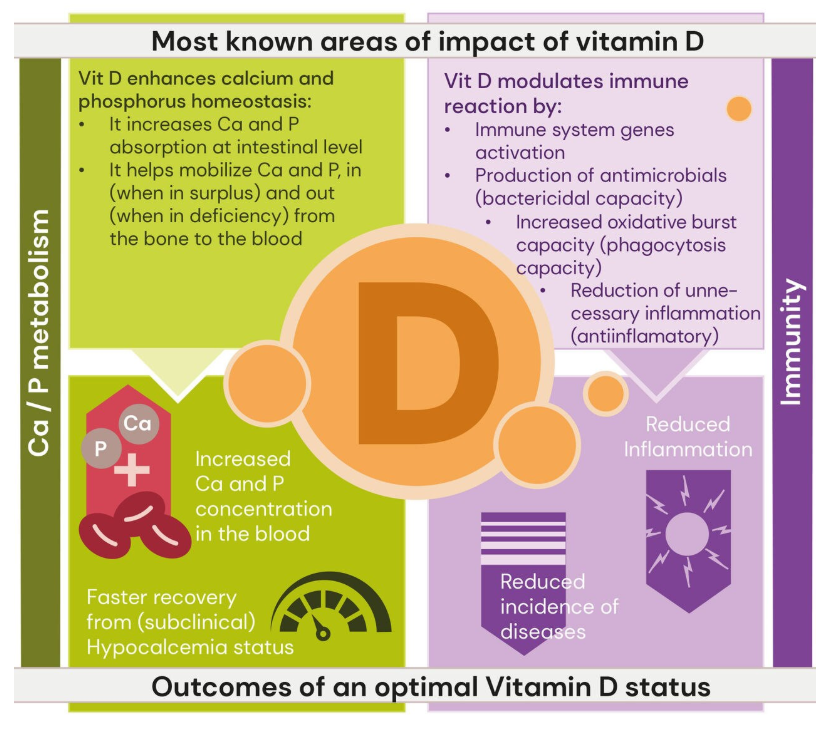
Vitamin D’s impact in the health of ruminants has gained relevance in the recent years, as well as in any other species. For ruminants, two clear areas of the impact of vitamin D in health are:
Optimal status: Vitamin D and milk yield
Both major known areas of impact of vitamin D – calcium and phosphorous metabolism and immunity - play a very important role on the health of the animals. Consequently, the energy balance results in the greater milk production capacity.
One of the main reasons health is critical for optimal milk production is the expense associated with activating the immune system of animals. Inflammation is a natural process, defending against pathogens that may impact health negatively. However, inflammation that is excessive in magnitude and length of time does result in harm to the animal (Brewer et al., 2020).
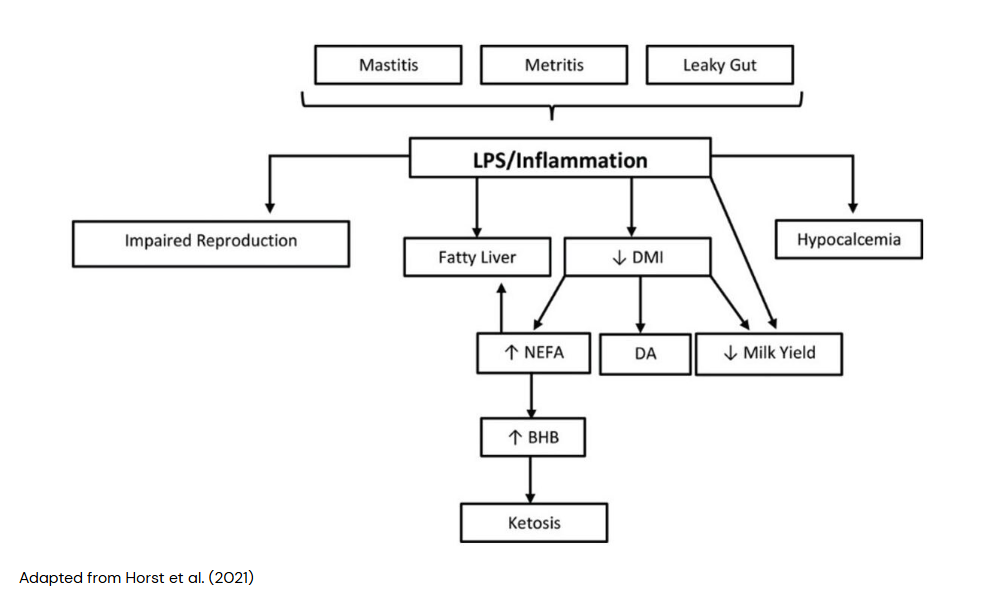
Root cause of diseases: Pathological inflammation can be harmful because it may act as the starting point of several diseases, as suggested by Horst et al. (2021). Inflammation commonly can result in failures such as fatty liver, ketosis, hypocalcemia, impaired reproduction and others. Any one of these diseases will limit the wellbeing of the cow and will limit her capacity to express her productive potential.
Energy expenditure: pathological inflammation also can result simply on a high energy expenditure for the animal. According to Kvidera et al. (2016), a dairy cow and a steer spend 0.64 and1.0g glucose/ kg BW0.75/h. An experiment using an LPS-euglycemic clamp to quantify the energetic cost of an activated immune system indicated a loss of approximately 1 kg of glucose used by the immune system, during a 12-hour period in lactating dairy cows. Therefore, the stronger and the more prolonged the immune reaction, the more likely this will result on reduced energy availability, resulting in milk losses.
Common health factors: is lack of Vitamin D limiting the milk yield?
Vitamin D3 or sun exposure are not enough
The two common ways of absorbing vitamin D are via the sun, or through feed, commonly as vitamin D3. However, there is a major limitation as to how much can a cow transform into 25-OH vitamin D3, which is later converted in the kidney into 1,25OHD3, the active form (Figure below).
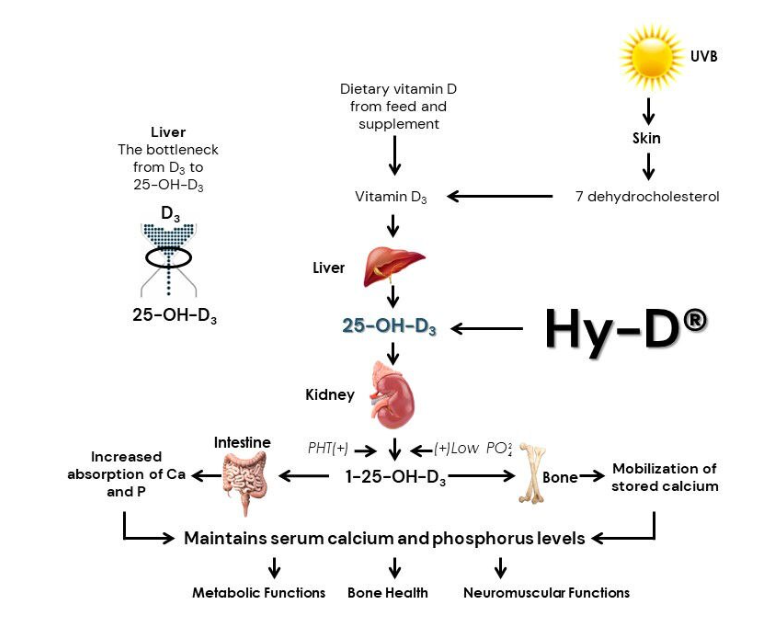
Vitamin D natural pathway and with Hy-D, bypassing the liver’s bottleneck.
Supplementing with products such as Hy-D® supports the cow in the metabolism of vitamin D3. It bypasses the critical first step of hydroxylation in the liver and reaches the blood stream quickly and efficiently. The key advantage of Hy-D® as a vitamin D source is that it bypasses the liver’s bottleneck and ensures the animal can reach blood levels associated with optimal immune function (Nelson et al., 2010).
Conventional vitamin D3 vs Hy-D®
The table below summarizes various dairy trials in dairy cows that compared conventional vitamin D3 supplementation with the use of Hy-D®. Hy-D® has been tested in different forms of application during dry period (green), during milking period (purple) and one trial covered both stages (blue).
Table 1. Summary of scientific trials with 25OHD3 supplementation on dairy cows and its impact on milk yield and health outcomes.
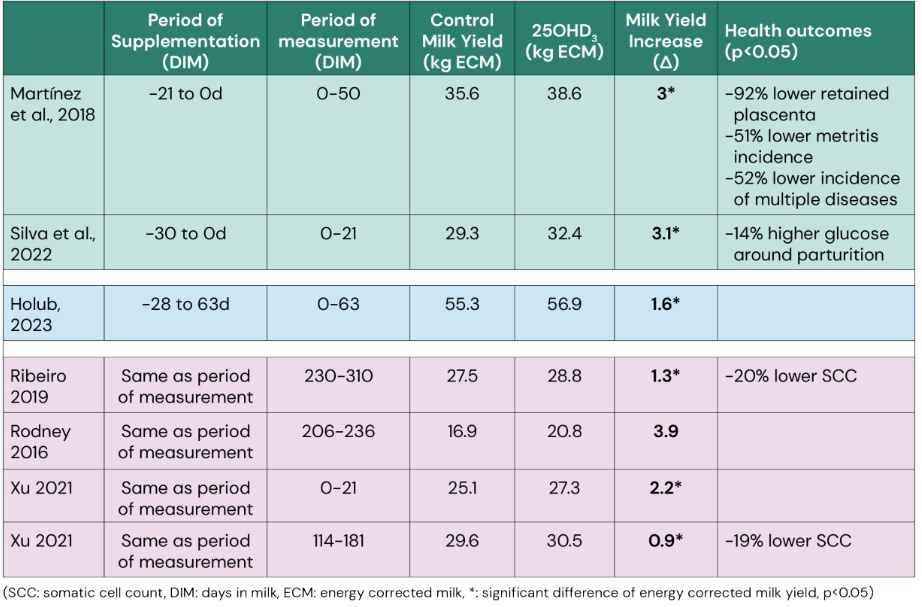
Most of the trials demonstrated significant positive impacts in health status for the animals (column “health outcomes”). The biggest impact of the use of Hy-D® on those trials was the enhanced health and resilience in all bovine categories (e.g. calves, heifers, beef) although the trials in the table above were all on dairy cows.
Consistently, Hy-D® led to higher milk yield, during both early and late lactation. The range of increase on ECM yield when comparing with vitamin D3 as a control was of 0.9 – 3.9 kg.
What’s next?
With Hy-D®’s new registration in the EU, farmers and nutritionists can consistently support improvement in milk yield, both during early and late lactation, at the same time as promoting a better health status, altogether enhancing the profitability of the farming system.
References available on request.