China to impose 55% beef tariff above import quotas
Safeguard caps 2026 imports at 2.7 million tonnes
 2 January 2026
 3 minute read
 By:
By: China will impose an added 55% tariff on beef imports that exceed quota levels from key suppliers including Brazil, Australia and the US in a move to protect its domestic cattle industry, reported Reuters.
China's commerce ministry said on Wednesday the total import quota for 2026 for countries covered under its new "safeguard measures" is 2.7 million metric tons, roughly in line with the record 2.87 million tons it imported overall in 2024.
The new annual quota levels are lower than import levels for the first 11 months of 2025 for top supplier Brazil, and Australia.
"The increase in the amount of imported beef has seriously damaged China's domestic industry," the ministry said in announcing the measure following an investigation launched last December.
The measure takes effect on January 1 for three years, with the total quota set to increase annually.
Beef imports to China fell 0.3% in the first 11 months of 2025 to 2.59 million tons.
Chinese beef imports will decline in 2026 as a result of the measures, said Hongzhi Xu, senior analyst at Beijing Orient Agribusiness Consultants.
"China's beef-cattle farming is not competitive compared with countries such as Brazil and Argentina. This cannot be reversed in the short term through technological advancements or institutional reforms," Xu said.
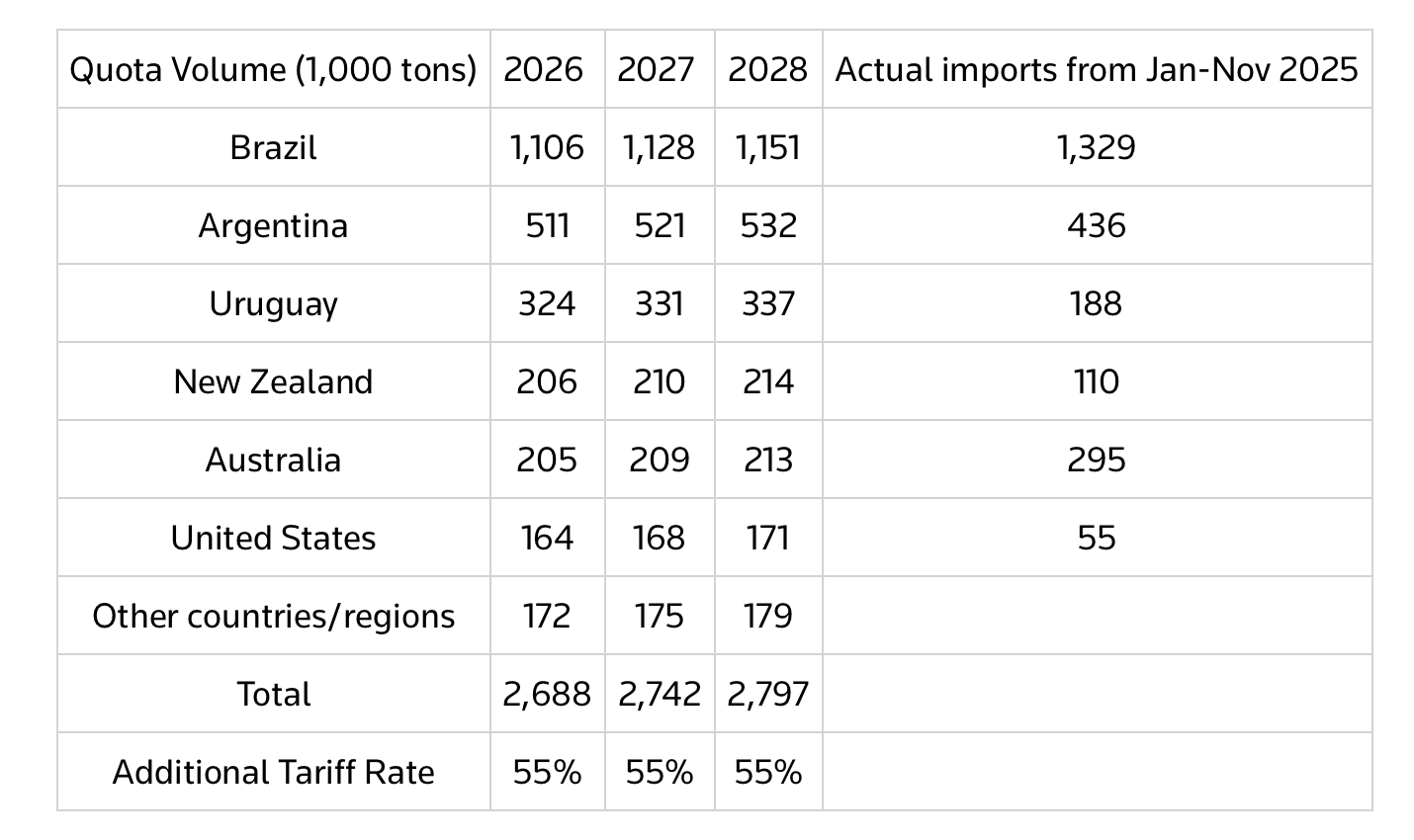
In 2024, China imported 1.34 million tons of beef from Brazil, 594,567 tons from Argentina, 243,662 tons from Uruguay, 216,050 tons from Australia, 150,514 tons from New Zealand, and 138,112 tons from the US.
In the first 11 months of this year, Brazil shipped 1.33 million tons of beef to China, according to Chinese customs data, higher than the 1.1 million tons set under Beijing's new measures.
Also this year, Australian shipments to China have surged, gaining share at the expense of US beef after Beijing in March allowed permits to expire at hundreds of American meat plants and as President Donald Trump unleashed a tit-for-tat tariff war. US shipments stood at just 55,172 tons through November, less than half the 2024 levels.
Australian beef exports to China stood at 294,957 tons in the first 11 months of 2025.
“We have made it clear to China that Australian beef is not a risk to their beef sector, and that we expect our status as a valued Free Trade Agreement partner to be respected," Australian Trade Minister Don Farrell told Reuters on Thursday, calling China's decision "disappointing".
The Australian government and beef industry were working closely to determine the full implications of the measure, Agriculture Minister Julie Collins said in an email reply to Reuters.
Beef shortage
China's move comes as a global beef shortage pushes up prices in many parts of the world, including to record highs in the US.
Responding to Beijing's announcement, Mark Thomas, chair of the Western Beef Association in Australia, said: "There's plenty of other countries that will take our product."
Luis Rua, secretary at Brazil's agriculture ministry, said there is no reason "to panic", telling Reuters that the government can negotiate "compensatory measures" with China to offset the impact of the new tariffs.
In a telephone interview, Rua also mentioned Brazil's ability to redirect beef exports to other countries.
Brazilian industry groups, on the other hand, expressed concern.
In 2025, Chinese imports of Brazilian beef totalled approximately 1.7 million tons, equivalent to some 48% of the volume exported by Brazil overall, beef lobby group Abiec said in a statement.
"Given this scenario, adjustments will become necessary throughout the entire supply chain, from production to export, to avoid broader impacts," Abiec noted.
Another major Brazilian beef lobby group Abrafrigo said the potential impact of China's safeguard measures could mean a loss of up to $3 billion in export revenue for Brazil in 2026.
This year, Brazil's total beef export revenues are estimated at $18 billion, Abrafrigo said.
Domestic protection
China made its announcement following two extensions of its beef import probe, which officials say does not target any particular country.
The tariffs will help curb the decline in China's breeding cow inventory and buy time for domestic beef enterprises to make adjustments and upgrades, said Zengyong Zhu, a research fellow of the Institute of Animal Science of the Chinese Academy of Agricultural Sciences.
Beijing has stepped up policy support for the beef sector this year and said in late November that cattle farming had been profitable for seven consecutive months.